
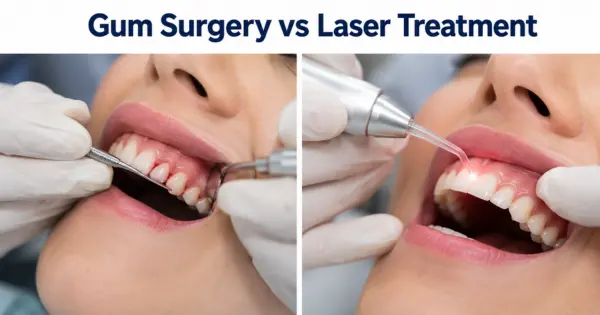
Laser Treatment vs Gum Surgery: Which Is Better?
If your dentist has told you that you need gum treatment, you may come across two options: laser gum treatment and traditional gum surgery. Naturally, one question comes to mind: Is laser treatment actually better?
The honest answer is not always. Laser treatment can offer advantages in selected cases, such as reduced bleeding and swelling and a more comfortable recovery. But traditional gum surgery remains important for certain conditions, especially when the gums or supporting tissues require more extensive treatment.
So, the right choice is not simply about choosing the newer technology. Your dentist needs to look at what is happening under your gums and how much treatment is required.
What Is Laser Gum Treatment?
Laser gum treatment uses a focused dental laser to treat affected gum tissue. Depending on the situation, the laser may be used to remove infected or unhealthy tissue, control bleeding, or reshape excess gum tissue.
It can be useful for conditions such as gum disease, excess gum tissue, gummy smiles, and some soft-tissue procedures.
One reason some patients prefer laser treatment is that it can be very precise. The dentist can target a specific area without affecting as much of the surrounding tissue.
However, laser treatment is not suitable for every gum problem.
What Is Traditional Gum Surgery?
Traditional gum surgery involves using dental instruments to access and treat the affected gum and supporting tissues.
For more advanced gum disease, the dentist may need to lift the gum tissue to see clearly and clean areas deep below the gumline. In some cases, treatment may also involve reshaping gum or bone tissue.
This does not mean traditional surgery is outdated or inferior. It remains an important treatment option when a condition requires direct access to deeper tissues.
The decision depends on the patient’s individual condition rather than on a simple choice between “old” and “new” technology.
Laser Treatment vs Traditional Gum Surgery
Both approaches have their place in dentistry, but they work differently.
| Bleeding | Often less bleeding during selected procedures | Bleeding may be more noticeable |
| Tissue treatment | Can provide precise treatment in suitable cases | Allows direct access to the treatment area |
| Stitches | May not be required for some procedures | May be required depending on the surgery |
| Recovery | May be quicker for certain procedures | Recovery depends on the type and extent of surgery |
| Suitable for | Selected gum and soft-tissue problems | A wider range of surgical gum conditions |
| Best choice | Depends on the condition | Depends on the condition |
These differences are general. Your experience can vary depending on the treatment, severity of gum disease, and your overall oral health.
Is Laser Treatment More Comfortable?
For many patients, one of the biggest attractions of laser treatment is the possibility of a more comfortable experience.
Laser treatment can reduce bleeding and may cause less swelling in some procedures. Some treatments also require fewer or no stitches.
But it is important not to assume that laser treatment means completely painless treatment.
Your comfort depends on the procedure being performed, the condition of your gums, and your individual sensitivity. Local anaesthesia may still be used when necessary.
Is Laser Treatment Faster to Heal?
Laser treatment may allow faster healing in some situations because it can cause less trauma to surrounding tissue.
But healing is not determined by technology alone.
For example, someone with advanced gum disease requiring extensive treatment may need more recovery time than someone having a small soft-tissue procedure.
Your dentist will consider the extent of treatment, gum condition, healing capacity, and aftercare when estimating your recovery time.
When Might Traditional Gum Surgery Be Better?
There are situations where traditional gum surgery may be the more appropriate option.
If gum disease has progressed to a more advanced stage and the dentist needs improved visibility and access to the tooth roots or supporting tissues, conventional surgery may be necessary.
Similarly, if the treatment involves significant changes to the gum or underlying structures, a surgical approach may provide the access the dentist needs.
This is why it would be misleading to say that laser treatment has replaced traditional gum surgery. It hasn’t.
Laser technology is another tool that can be extremely useful when it is appropriate for the particular case.
So, Which One Is Better for You?
The better treatment is the one that properly addresses your specific gum problem.
For example, a patient with excess gum tissue may benefit from a laser procedure, while another patient with advanced periodontal disease may need conventional gum surgery.
Before recommending treatment, a dentist may examine:
- The depth of your gum pockets
- Gum inflammation and bleeding
- The amount of gum recession
- The condition of the teeth and roots
- Bone loss around the teeth
- The presence of infection
- Your overall oral health
Sometimes, laser treatment may be enough. In other situations, traditional surgery may be more appropriate. In selected cases, different treatment methods may also be used together.
What Should You Ask Your Dentist?
If you’re being advised to have gum surgery, don’t hesitate to ask why a particular approach has been recommended.
You can ask:
- What is causing my gum problem?
- How advanced is my gum disease?
- Can laser treatment be used in my case?
- What would traditional surgery involve?
- How long might recovery take?
- Will I need stitches?
- What happens if I delay treatment?
These questions can help you understand your options instead of choosing a treatment simply because it sounds more modern.
Laser Gum Treatment at Dentistree
At Dentistree Advanced Dental & Implant Center, the treatment approach depends on the condition of your gums and the type of procedure required. During your consultation, the dentist examines the gums and surrounding tissues to determine the appropriate treatment.
When laser dentistry is suitable, it can be used for selected gum and soft-tissue procedures. For cases where conventional gum surgery provides better access or treatment, that option may be recommended instead.
You can learn more about how laser technology is used in different dental procedures on our Laser Dentistry in Bangalore service page.
Final Thoughts
So, is laser treatment better than traditional gum surgery?
Sometimes—but not for everyone.
Laser treatment can offer advantages such as precise tissue targeting, reduced bleeding, and potentially easier recovery for selected procedures. Traditional gum surgery, however, remains valuable when deeper or more extensive treatment is required.
The most important thing is not whether the treatment is performed with a laser. It is whether the treatment is appropriate for the actual condition of your gums.
A proper dental examination can help determine which approach is likely to give you the best result.
Frequently Asked Questions
Is laser gum treatment better than traditional gum surgery?
Not always. Laser treatment can be beneficial for selected gum procedures, while traditional surgery may be more suitable for advanced or complex conditions.
Is laser gum treatment less painful than traditional surgery?
Laser treatment may be more comfortable for some procedures, but discomfort varies depending on the treatment and the patient’s condition.
Does laser gum treatment heal faster?
Healing may be faster for some laser procedures, but recovery depends on the extent of treatment and the patient’s individual healing.
Can laser treatment replace gum surgery?
No. Laser treatment cannot replace traditional gum surgery in every situation. Some conditions require conventional surgical access.
How does a dentist decide between laser treatment and gum surgery?
The dentist considers the severity of gum disease, gum pocket depth, bone loss, affected tissues, and the type of treatment required before recommending an approach.

Dr. Samreen Farrah Siddiqui is a compassionate and experienced dental professional dedicated to providing exceptional oral care. A trusted dentist in Bangalore, she is the founder of Dentistrée Advanced Dental Center in Bangalore, offering a wide range of treatments, including general, orthodontic, restorative, and cosmetic dentistry. With a strong commitment to ethical practice and long-term oral health, Dr. Samreen Farrah Siddiqui ensures every patient receives personalised, high-quality dental care in a welcoming environment.